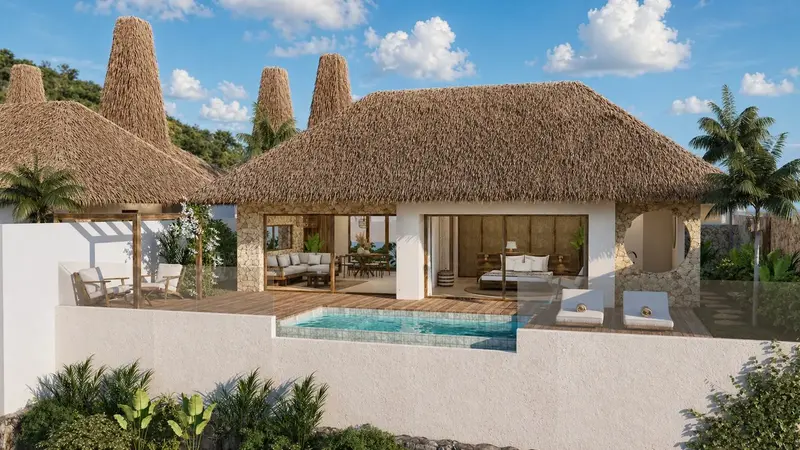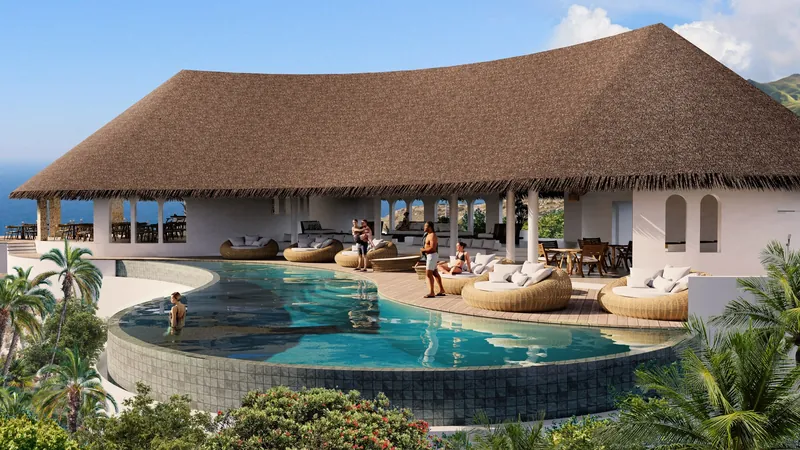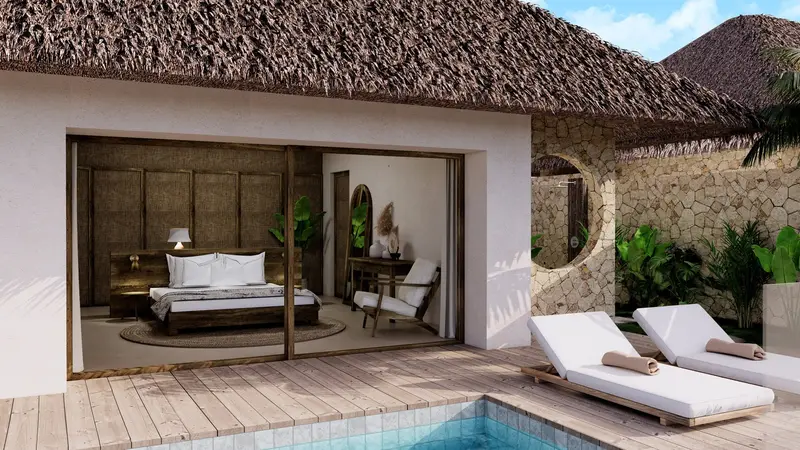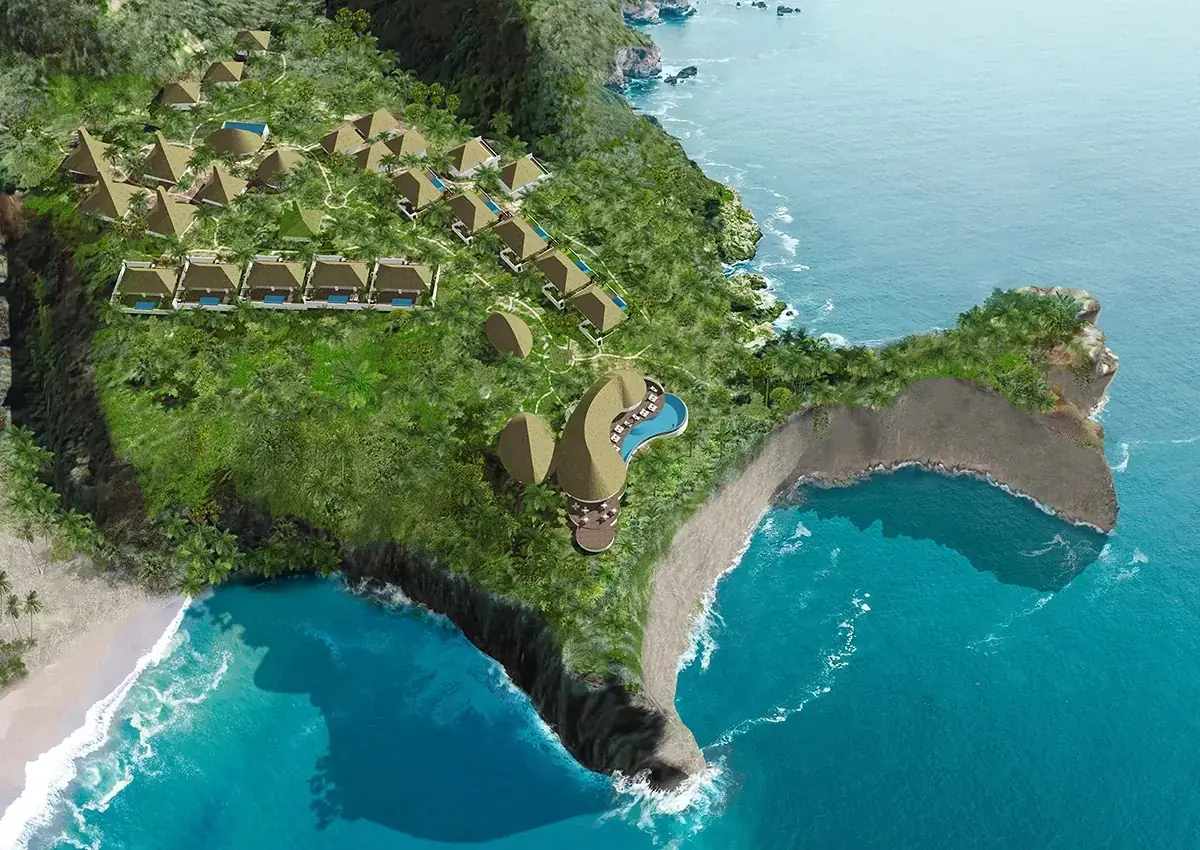
Sumba is still a quiet island, and its public networks are still being built out. When you build here, you do not connect to what exists. You install it. Here is how Kabisu produces its water and its power, how the property stays online, and above all what happens on the day one of the three stops.
Here is how each of the three works, and what takes over when it does not.
Connect, or provide
In most places where you build a hotel, water and electricity are paperwork. You file an application, you pay a connection fee, and the question is settled for good.
In Sumba each essential resource is a project of its own. Water has to be found before it can be pumped. Power arrives, though not always at the hour you need it. Fibre does not exist.
That sounds like a constraint. It is mostly a discipline. It forces a question nobody asks in a city: what happens when this stops? The rule we set for the property fits in one sentence. Every essential resource has a primary source and at least one backup that does not depend on the first.
That last part is what matters. A second pump on the same borehole is not redundancy.
Water, found before it is pumped
Drilling on a hunch is the fastest way to spend a great deal of money on a well that gives nothing.
Before any machine came onto the land, the property was surveyed with a geoelectric study. The principle is easy to follow: you send a current into the ground and measure how strongly the ground resists it. Hard rock conducts badly, water-bearing formations conduct well. Move the measurements around, stack them, and you get a cross-section of what lies beneath, where the water sits, how deep it is and how thick the layer runs.
The survey covered three test points across the land. It confirmed usable aquifers, and more importantly several separate sources, which was the real point of the exercise. One productive borehole is a single point of failure. Several independent boreholes are an infrastructure.
Above the boreholes the setup is conventional and proven. Storage tanks act as a buffer, which absorbs peaks in demand and buys time to work on a pump that has failed.
As a last line of redundancy, the site sits on the ocean, and a seawater desalination unit remains possible. That is the belt on top of the braces, and it is also why a coastal resort has fewer water worries than a project inland.
Then there is consumption itself, which is the most effective lever of all. Greywater is recycled, fixtures are chosen for how little they use, and the garden is designed around permaculture, which keeps watering low rather than compensating for it.
Power, three independent sources
The resort runs on three sources, and what counts is that none of them depends on the other two.
Solar is the primary source during the day. The array is sized to cover demand through daylight hours, which at this latitude is when most of the work happens: kitchens, air conditioning, pools, laundry.
The national PLN grid takes over at night and tops up whenever demand runs past what the sun is producing. Sumba is connected, with the reliability of a developing island grid, which means occasional outages.
The backup generator starts on automatic transfer. Nobody walks out to pull a cord in the middle of a storm. The switch happens on its own and the guest does not notice it.
Day to day that gives a simple rhythm: sun during the day, grid at night, generator when the grid drops. Dinner in the restaurant carries on when a line goes down somewhere along the coast.
Connectivity, Starlink and a 5G network in progress
This is the area that has changed the most in the last few years, by a wide margin.
Starlink gives the property fibre-equivalent throughput over low-earth-orbit satellite, with no dependence on any ground infrastructure. An excavator cutting a cable at the far end of the island has no effect here.
For redundancy, the local mobile network covers the area on 4G, and 5G is rolling out across the island. That is the second route, the one that carries the load if the first is unavailable.
WiFi covers the villas and the common areas. In practice you can hold a video call from a villa on the cliff above the ocean. For an owner renting the villa out, that has become a booking criterion in its own right.
Wastewater and waste
Treating on site is the only honest option when there is no municipal plant anywhere nearby.
The property runs a Biotank system, a biological treatment rather than a chemical one: bacteria do the work, inside a sealed tank.
Greywater is recycled, and nothing untreated leaves the property. On land at the top of a cliff, above a coastline that is still intact, that one is not negotiable.
On waste, sorting is in place and organic waste goes to compost, which comes back to the garden. Plastic is cut back as far as it can be at source, meaning at the point of purchase, because that is where the decision is actually made. What still has to leave the site goes through local channels.
This matters to us, and we have already done it with other resorts in Indonesia. We will not be perfect, and we would rather say so. We do the best we can with what the island really offers.
The garden
The property grows in permaculture: vegetables, herbs, fruit, and a hen house for eggs.
Food self-sufficiency is not the goal, and it would be an empty promise for a restaurant serving guests all year. The point is to grow what can sensibly be grown here, at a quality and a freshness no delivery matches, and to buy the rest from producers on Sumba.
Compost closes the loop with the kitchen waste.
What it changes when you are there
Infrastructure that works is infrastructure you never notice.
Water runs. The lights stay on. The WiFi works. Nobody thinks about a geoelectric survey while taking a shower, and that is exactly the point.
The difference shows up in the moments where, somewhere else, it would have shown: the 9pm outage that cuts nothing, the work call that connects, the pool still full at the end of the dry season.
For a villa owner the reading is a little different. These choices turn into occupancy that does not slide after the first breakdown, and guest reviews that say nothing about power cuts. That is what separates a project that works on paper from a resort that runs, a subject we go into in Beyond Renders & Spreadsheets.
And to come and see it for yourself, getting to Sumba is easier than most people expect.