Investors ask about maintenance right after they ask about returns: who looks after the villa, and at what cost, when its owner lives on another continent. The answer follows from the way Kabisu operates. The villas run as a pool: rental income is shared across them, and so is maintenance.
It starts with who actually does the work.
The team that maintains the villas
The villas are maintained by the resort's own salaried team. Kabisu does not outsource this work: the same staff who run the hotel service also look after the villas, with a daily pass covering housekeeping, linen, the pool, the garden and technical checks.
The owner has nothing to arrange. There is no maintenance contact on the owner's side, because nothing travels up to them: maintenance decisions sit with the operator, who takes them and carries them out with its own teams. The villa is kept to the same standard as the rest of the resort, whether its owner is on site or abroad.
Keeping a salaried team year round costs more than calling in tradesmen as needed. It is an operator's choice, and it only works at the scale of a resort: a single villa does not generate enough work to keep a permanent team busy.
Maintenance is pooled, the same way income is
Kabisu villas operate as a pool: rental income from all the villas is collected together, then distributed to investors in proportion to their holding. Maintenance follows exactly the same rule. Costs are carried by the pool, never by one villa in particular.
For the investor. A villa that needs more attention in a given year does not penalise its owner, and a villa that needs less does not create a privilege. The natural differences between buildings, in exposure, wear or plain luck, are absorbed by the whole, on costs as on income.
Compared with a stand-alone villa. Owned on its own, a villa exposes its owner to every one of its breakdowns: the expense arrives unannounced and lands on one person. The pool turns those shocks into a steady, predictable operating cost.
What pooling pays for. The permanent team, the stock of spare parts and the Renovation Reserve Fund described below only exist because they are funded at the scale of the resort. It is the mechanism described in the villa pool, extended to the spending side.
What the 10% of maintenance covers
Net rental income, meaning income after VAT and booking platform fees, is split three ways: 60% to investors, 30% to management, 10% to maintenance.
Management and operations, 30%. Staff salaries and supervision, administration, marketing, insurance, accounting: the day-to-day running of the resort.
The 10% of maintenance splits in two.
Day-to-day maintenance, 5%. Air-conditioning service, electrical and plumbing inspections, the pool and water system, pest control, cleaning equipment and supplies. It also absorbs the daily wear of a hotel, linen to renew, glassware to replace.
Renovation Reserve Fund, 5%. The provision for major works, detailed below.
Investors therefore never receive a maintenance bill: these costs are settled at source, and distributions arrive net of all of it.
What the ocean does to a building
A building on the ocean ages faster than one inland: salt air works on metal continuously, in every season. A large part of the first ten years' maintenance bill is decided at construction, in the choice of materials.
The ceiling fans. By the sea, a metal ceiling fan corrodes within a few years, even a high-end one. A well-made black plastic fan gives the same look, does not corrode and lasts far longer. Those are the ones in the villas.
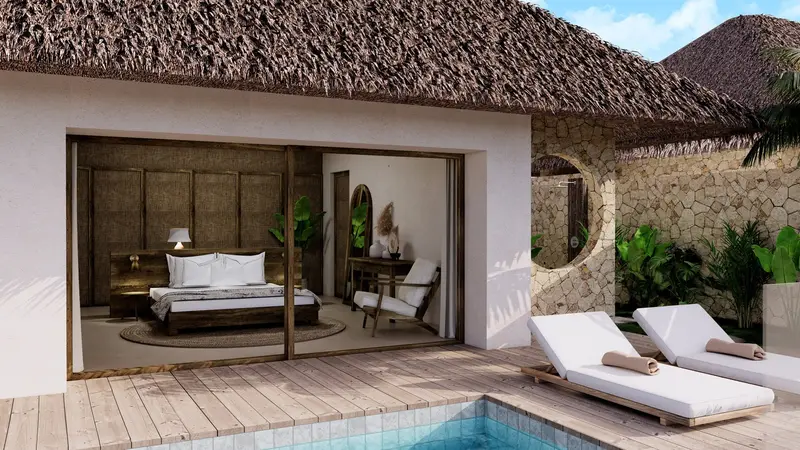
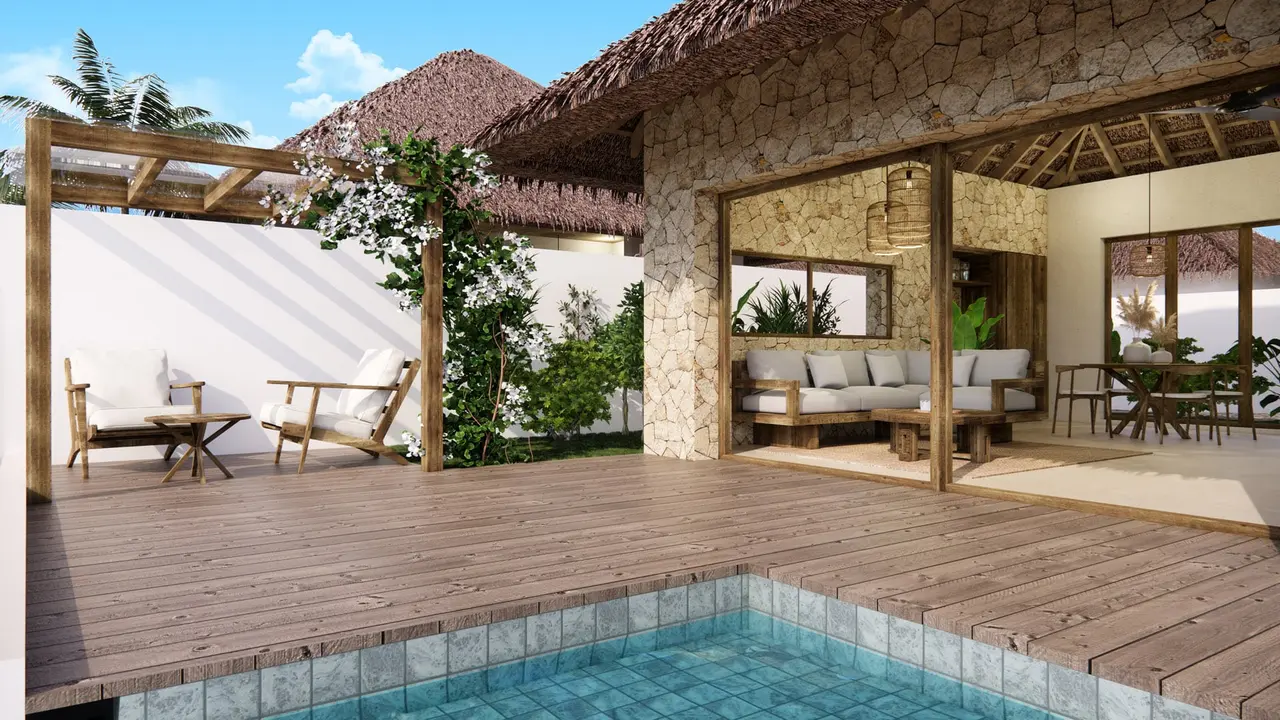
Stone and wood. Some stones turn black on contact with water and were ruled out. Wood is chosen for its exposure: decks and outdoor furniture call for species that stand up to salt air and rain, and that choice is made at the design stage.
These decisions draw on the resorts our co-founders already run in Indonesia: years of watching how each material ages against the ocean, fed straight into how Kabisu is built.
Spare parts and supply
On an island, the main constraint is lead time. Three decisions cut it down.
Standardisation. Equipment is identical from one villa to the next: the same pool pump, the same air-conditioning unit, the same fittings. Decided at the design stage, that uniformity reduces the number of references to cover and makes a stock viable.
Stock on site. The parts the operation depends on are doubled on site: one spare pump rather than ten, and the same principle up to the generator. The installations involved are described in how a remote Sumba resort runs.
Bali next door. Sumba is an hour's flight from Denpasar, with several connections a day. A part that cannot be found on the island is bought in Bali the same day, travels in the hold of the next morning's flight and lands in Tambolaka before midday.
The Renovation Reserve Fund
A thatched roof gets redone. A pump reaches the end of its life. A bathroom gets renovated. These costs are known in advance, and they are provisioned from day one.
That is the role of the Renovation Reserve Fund: 5% of net income flows into it continuously, planned over a twenty-year horizon. The reserve is dedicated to major works, structural renovation and the renewal of equipment; it is not used for day-to-day operations. When a roof needs redoing, the provision already exists, and the villa keeps, year after year, the standard that justifies its nightly rate.
Routine maintenance never stops: the teams work year round. Heavy work is scheduled for the low season, when occupancy allows a villa to be taken out of service.
What maintenance protects
For an investor, maintenance protects the income directly. A villa kept to hotel standard books at the intended rate, season after season, and its real condition shows in guest reviews. Occupancy and reviews make the pool's income; constant maintenance keeps them safe.
It is also the reasoning behind the construction choices described in Kabisu Villas, designed from the start to last in this climate.